Mitasys × Rustomjee · Website Migration Impact

Validating the migration findings, and the plan to recover Premium & Super Premium.

The site migrated on 22 February 2026. This page checks the three initial findings against Google Search Console and rank-tracking data, separates what the migration caused from wider search trends, and sets out the recovery already underway.

At a glance

The three findings, validated.

Overall lead volumes are recovering, but Premium and Super Premium remain roughly half of pre-migration levels. The data confirms findings 1 and 2; finding 3 needs reframing: the redirects were correct, and most of the residual loss is concentrated in blogs and is an industry trend, not a redirect error.

Finding 1

Rankings fell from 4th to outside the top 30

Validated

Confirmed for non-branded location keywords, with Premium and Super Premium hit hardest. The trough was May; June is recovering.

Finding 2

Organic traffic dropped ~25% post migration

Validated

Organic clicks fell 27% in the first month and 35% in the most recent month. Blogs are by far the largest contributor.

Finding 3

Pages were not redirected properly / missed backlinks

Needs context

Redirects were mapped and implemented correctly. The loss is driven by URL changes being re-evaluated (now resolving) and by AI Overviews suppressing blog clicks.

Finding 1 · Keyword rankings

Top-10 visibility fell after migration, deepest in Premium & Super Premium.

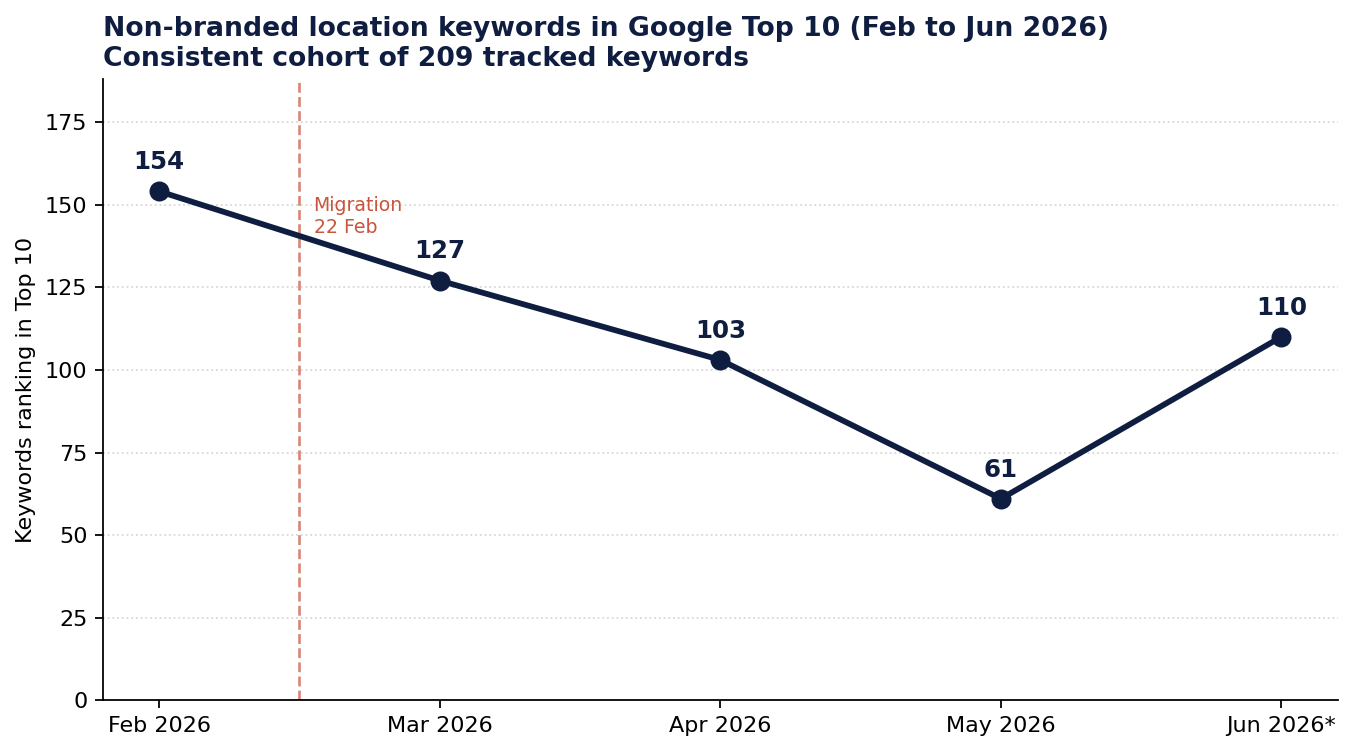
Across a consistent set of 209 non-branded location keywords (the terms that bring high-intent buyers before they know the brand), the number ranking in Google's top 10 fell month on month after migration, bottomed in May, and began recovering in June.

Line chart: non-branded location keywords in Google top 10, falling from 154 in February to 61 in May, recovering to 110 in June 2026.
Keywords in the top 10 fell from 154 (Feb, pre-migration) to 61 (May), then rebounded to 110 in June as the new location pages began to index. Jun is a mid-month snapshot.
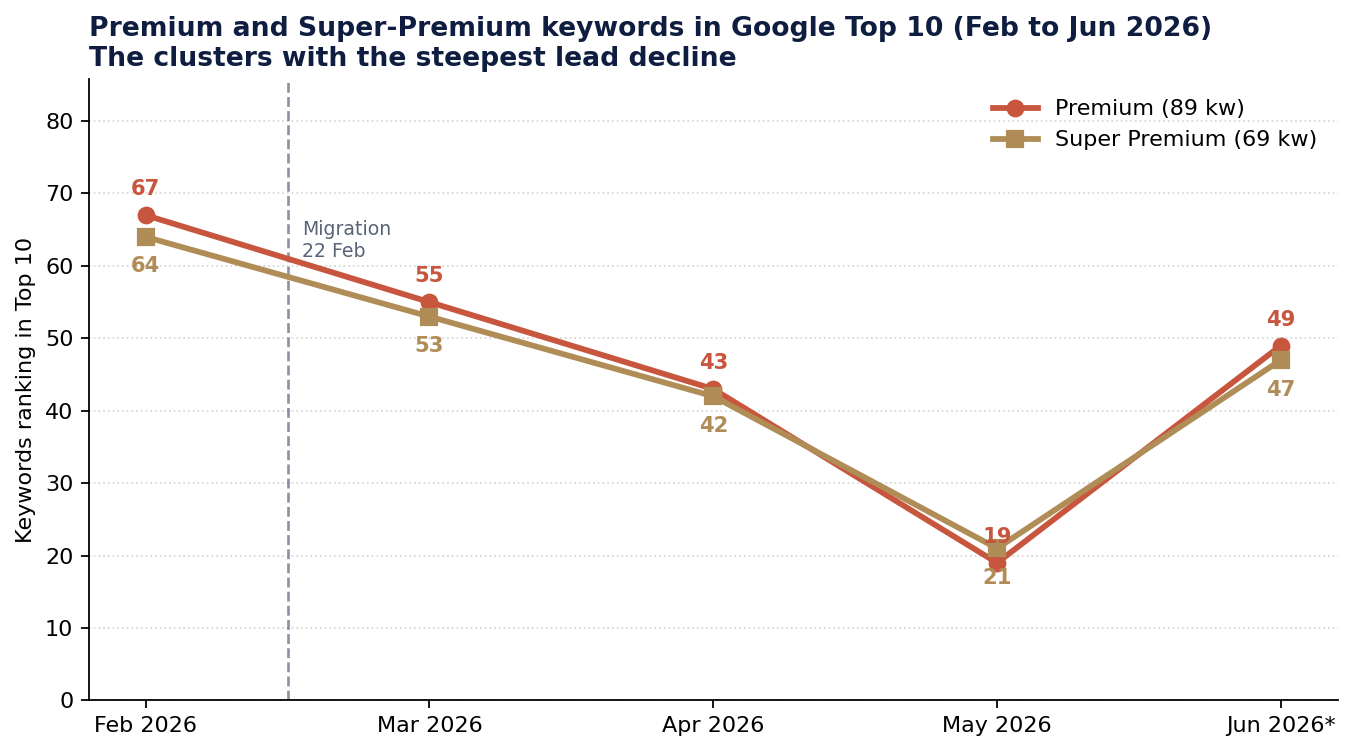
Line chart: Premium and Super Premium keywords in the top 10 fell from the high 60s in February to under 20 in May, recovering to high 40s in June 2026.
Premium (89 keywords) and Super Premium (69 keywords) tracked almost identically: from 67 / 64 in the top 10 down to 19 / 21 in May, recovering to 49 / 47 in June.

Verdict: Validated

The finding holds. For example, "3 bhk in pali hill" (a Premium / Super Premium term) sat at position 4 in February and dropped outside the top 30 by April. In total, 28 keywords fell from a top-5 position to outside the top 30. The Premium and Super Premium clusters lost the most, which is consistent with the lead softness in those segments. June shows the start of a recovery.

Open the ranking report sheet →

Finding 2 · Organic traffic

Organic clicks are down, and blogs are the largest contributor.

Comparing 30-day windows against the pre-migration baseline (23 Jan to 21 Feb), organic clicks fell 27% in the first month after migration, and 35% in the most recent month. This validates the ~25% the team reported, and shows the gap has widened as Google continues to re-evaluate the new URLs.

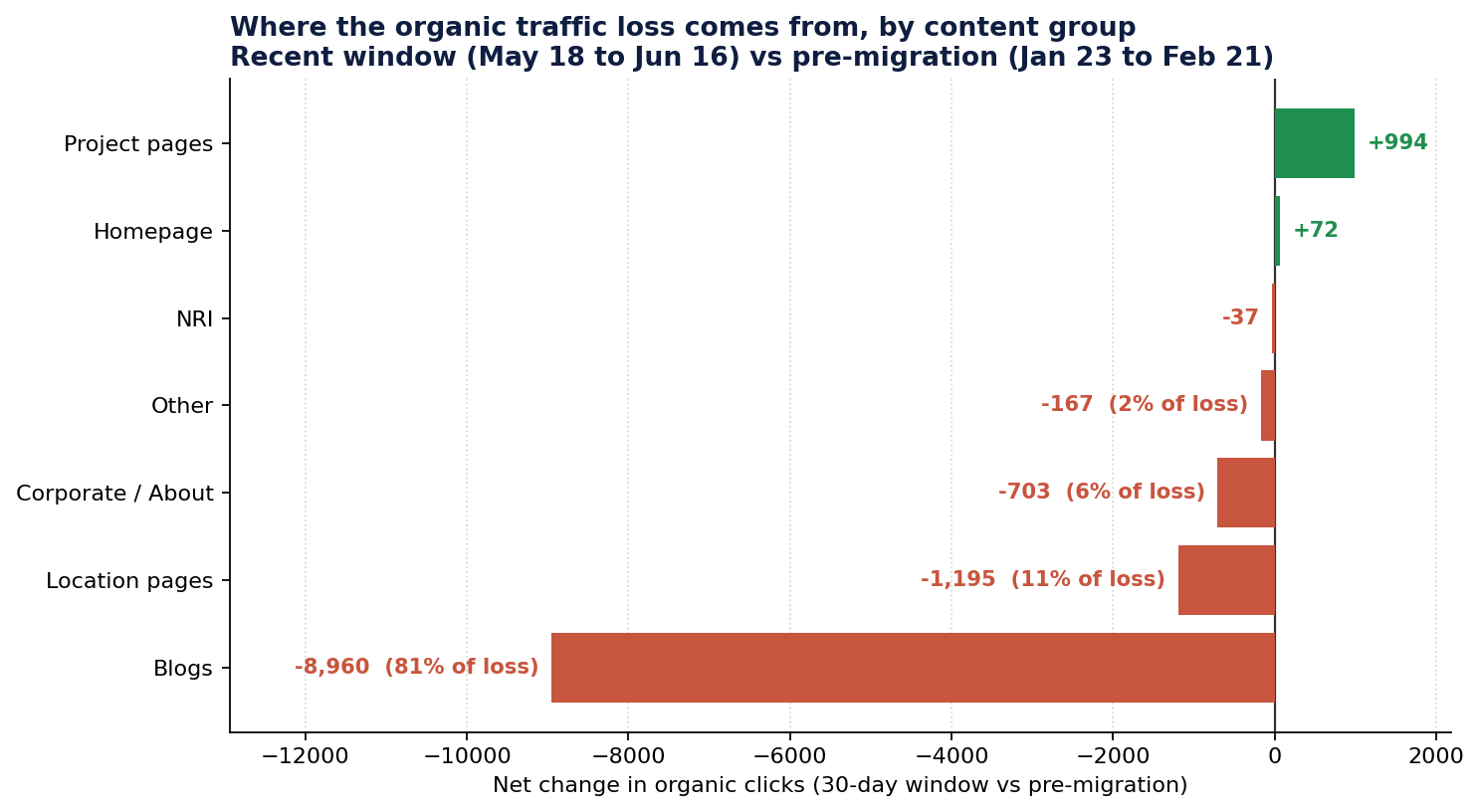
Bar chart: blogs account for 81% of the recent organic click loss; location pages 11%; project pages and homepage recovered.
Blogs account for 81% of the recent loss (62% in the first month). Crucially, project pages (+25%) and the homepage (+2%) have already recovered; the residual loss is concentrated in blogs.
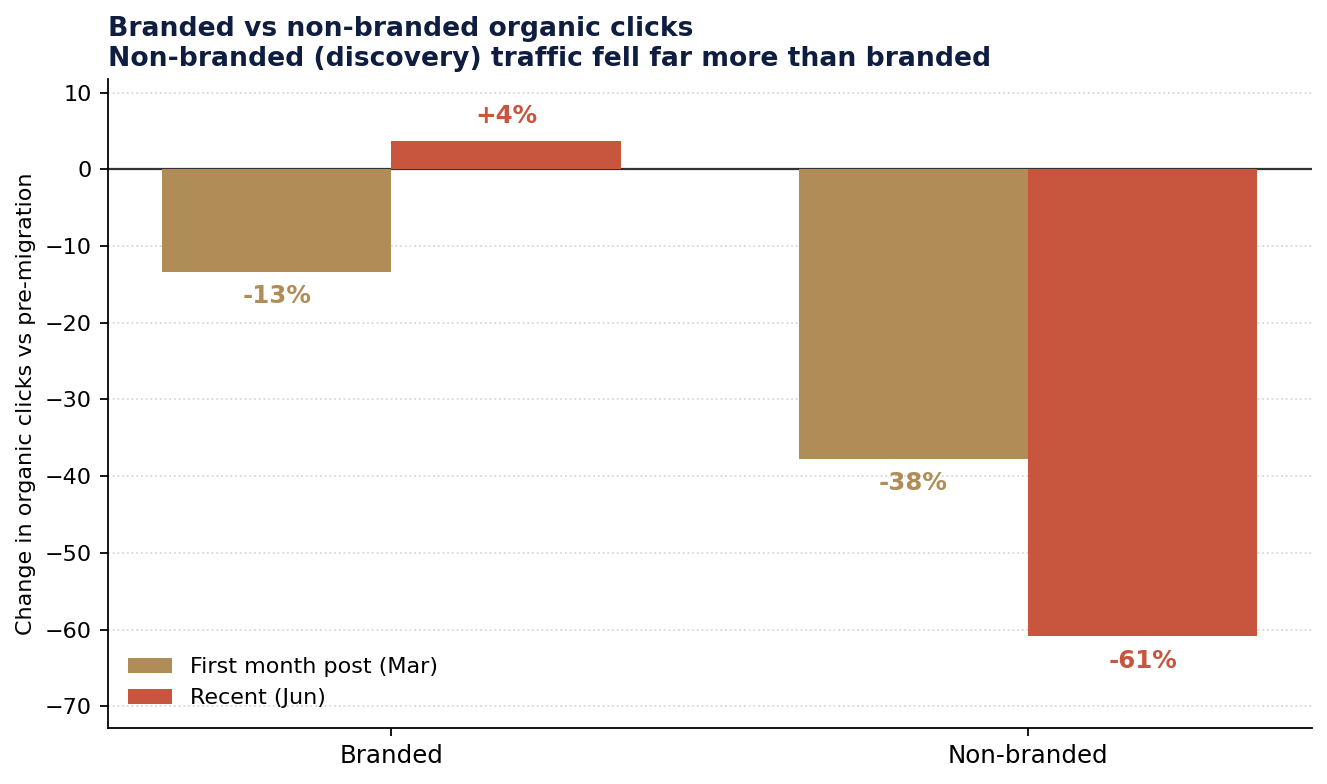
Bar chart: branded clicks recovered to +4% while non-branded clicks fell from -38% to -61%.
Branded search (people typing "rustomjee") has fully recovered to +4%. Non-branded, discovery search keeps falling, from -38% to -61%, and non-branded is dominated by informational blog queries.

Verdict: Validated

Organic traffic is down as reported. Blogs are the single largest contributor and the share is rising (62% then 81% of the loss). Branded traffic has recovered; the persisting decline is non-branded, which points to the cause covered in finding 3.

Finding 3 · Redirects & backlinks

The redirects were correct. The loss is URL re-evaluation plus AI Overviews.

The migration mapping covered 1,123 URLs, each validated on staging before go-live. The traffic loss is not from missed or broken redirects; it comes from changing the URL on a large part of the site, and from a wider shift in how Google shows informational results.

URLs mapped

1,123

Every URL classified before go-live

Kept the same URL

728

No change, including most blogs

Redirected (301)

280

Mapped old → new, staging-checked

Changed URL path

354

~39% of pre-migration clicks

Why changing URLs costs traffic, temporarily

Every project page moved from /residential-property/ to /projects/residential/, and the location pages were restructured under /mumbai/ and /thane/. When a URL changes, Google re-evaluates and re-consolidates its authority and backlinks onto the new address, which takes weeks to months. This is expected and is already resolving: project-page clicks have recovered to +25%.

Why blogs keep falling: AI Overviews

Blogs are the largest section and mostly kept the same URL, yet they lost the most traffic, so this is not a migration effect. Google now answers informational queries directly with AI Overviews and AI Mode, which removes clicks even when the page still ranks. For "stamp duty and registration charges" the position held (1.8 to 2.0) but clicks fell; for "aqua line metro" impressions actually rose (15.2k to 19.0k) while clicks dropped from 695 to 90. This is an industry-wide trend, outside our control.

Verdict: Correct redirects, reframed cause

"Not redirected properly" is not accurate: the mapping was implemented and validated. The real drivers are URL-change re-evaluation (temporary, resolving) and the structural decline of informational blog clicks to AI Overviews (external). The recovery plan focuses on the high-intent location and project pages that convert, rather than informational blogs.

Open the URL mapping sheet →
Recovery plan

Rebuilding Premium & Super Premium visibility.

The recovery is led by non-branded location pages, the exact terms that lost top-10 visibility and that drive Premium and Super Premium discovery. Two substantial programmes are already shipped, and the June ranking rebound coincides with the first of these going live.

What comes next

  1. Prioritise Premium & Super Premium location and project pages in the ongoing location-page rollout and internal-linking, since these are the clusters still below pre-migration levels.
  2. Let the URL re-evaluation finish. Project pages have already recovered to +25%; we will keep monitoring authority reconsolidation on the changed URLs and flag any redirect that under-recovers.
  3. Shift weight from informational blogs to high-intent pages. Because AI Overviews structurally suppress blog clicks, recovery effort is best spent on location and project pages that convert and are less exposed to AI Overviews.
  4. Run alongside the Rustomjee workstream on Core Web Vitals, mobile experience, and form / CTA visibility, so SEO recovery and conversion improvements compound.

Sources

The data behind this page.

Every figure here is drawn from Google Search Console, the rank-tracking report, and the migration mapping. The detailed write-up walks through each finding in full.

1

Detailed write-up

The full validation of findings 1 to 3 and the recovery plan, with the same charts and the underlying numbers.

Open the document
2

Ranking report

Monthly non-branded keyword rankings by segment, the source for finding 1.

Open Sheet
3

URL mapping

The full migration redirect map (1,123 URLs), the source for finding 3.

Open Sheet